
Reviewed · THAI COOKING CLASSES
Sukhumvit: Hands-on Thai Cooking Class & Market Tour in BKK
Come hungry, leave with recipes. This 210-minute class turns Thai food from something you order into something you can make, starting with fresh ingredients and ending with four hot dishes at your own table. I especially like the hands-on curry paste and the friendly teaching style of instructors such as April, Jay, Pitch, and May. The main drawback is that only the morning class includes the market tour. Afternoon and evening sessions replace it with mango carving, and finding the school can take a little patience.
I also like the clear daily menu, since you can choose a class day based on your favorite Thai dishes. The $45 price covers ingredients, equipment, water, a locker, the four-course meal, and recipes sent by email. Give advance notice for vegetarian, halal, kosher, or allergy requests, and wear comfortable shoes.
In This Review
- Key points at a glance
- Meeting at Asoke and getting oriented
- The morning market: Thai ingredients in their natural setting
- Afternoon and evening options: mango carving instead
- A clean kitchen and well-organized cooking stations
- Making curry paste with your own hands
- Four dishes, cooked and eaten one at a time
- What the teaching feels like in practice
- Is $45 a fair price?
- Who should book this Sukhumvit class?
- Should you book it?
- FAQ
- How long does the Thai cooking class last?
- Where does the morning class meet?
- Where do the afternoon and evening classes meet?
- Does every class include a market tour?
- How many dishes will I make?
- Can the class accommodate dietary requirements?
- What is included in the $45 price?
Key points at a glance
- Morning market visit: Walk through a nearby local market and learn about Thai vegetables, herbs, rice, spices, and sauces before cooking.
- Curry paste from scratch: Pound and combine the ingredients yourself rather than relying only on a prepared jar.
- Four dishes in one class: You cook and eat each dish while it is fresh, with menus changing by day.
- Strong instructors: April, Jay, Pitch, and May are praised for clear instructions, humor, and patient guidance.
- Recipes to take home: A standard recipe PDF arrives by follow-up email, giving you a useful souvenir beyond photographs.
- Flexible class times: The morning session has the market tour, while afternoon and evening sessions include mango carving instead.
Meeting at Asoke and getting oriented
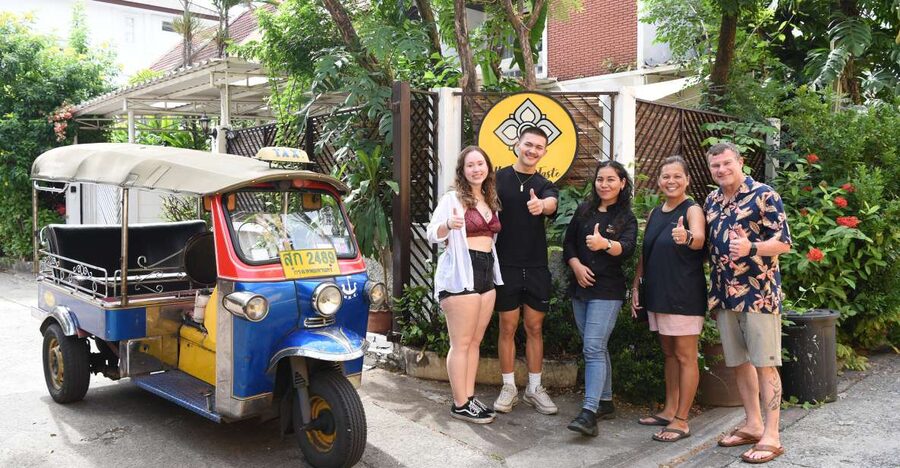
For the morning class, meet at street level near BTS Asoke Exit 3 and MRT Sukhumvit Exit 3. You can also use Hey! Coffee MRT Sukhumvit as a map pin. This is a practical meeting point because Asoke is one of Bangkok’s easiest transport connections, but do not rush away if you do not immediately see a cooking-school sign.
One participant arrived early and had trouble identifying the entrance. The school helped after a passerby called, but the experience suggests a simple precaution: arrive early, keep the meeting details handy, and confirm that you are at the correct street-level spot before walking on. The afternoon and evening meeting point is different. Go directly to the school in Sukhumvit 4 for those sessions.
The total activity lasts 210 minutes, or three and a half hours. That is long enough to include food shopping, instruction, cooking, and eating without turning the class into a rushed demonstration. You should wear comfortable walking shoes, especially for the morning outing.
More Markets and Floating Markets in Bangkok
- Bangkok: Damnoen Saduak Market and Maeklong Railway Market
★ 4.5 · 26,723 reviews - The Old Siam: Damnoen Saduak and Maeklong Railway Market
★ 4.5 · 10,992 reviews - Bangkok: Train Market & Floating Market with Boat Ride
★ 4.7 · 9,547 reviews
The morning market: Thai ingredients in their natural setting
The morning class begins with a guided visit to a nearby market. This is more useful than simply being handed a tray of premeasured ingredients. You get to see the raw materials first, learn what they look like, and connect the finished dish with the produce used to make it.
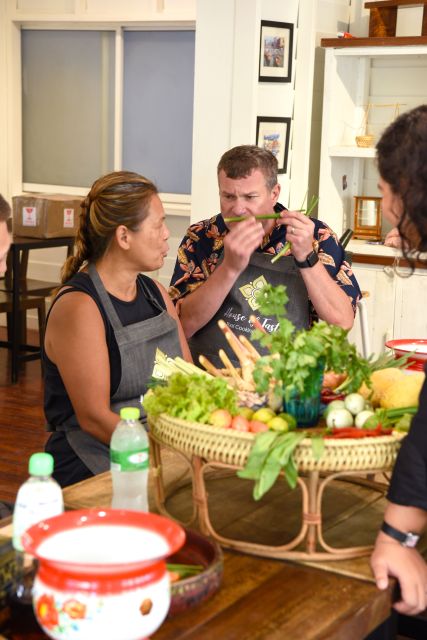
The introduction covers vegetables, rice, herbs, spices, and other Thai ingredients. You also learn about coconut milk and the components of curry paste. For someone who cooks mostly from supermarket labels, this part can make Thai recipes much less mysterious. It helps you recognize the ingredients you will later need at home.
The market visit is also the most local part of the morning. You are not just looking at a cooking-school pantry. You are seeing where the class sources its produce and hearing explanations before the cooking begins. April and Jay are both praised for making this ingredient lesson lively and easy to follow.
Keep your expectations in check. The market tour is an ingredient-focused walk, not a long cultural lecture. One person wanted more explanation about the history and importance of each dish, and another felt the market details could have gone further. If you want a full food-history tour, this class may feel light on that subject. If you want to know which herb goes into your curry, it should do the job well.
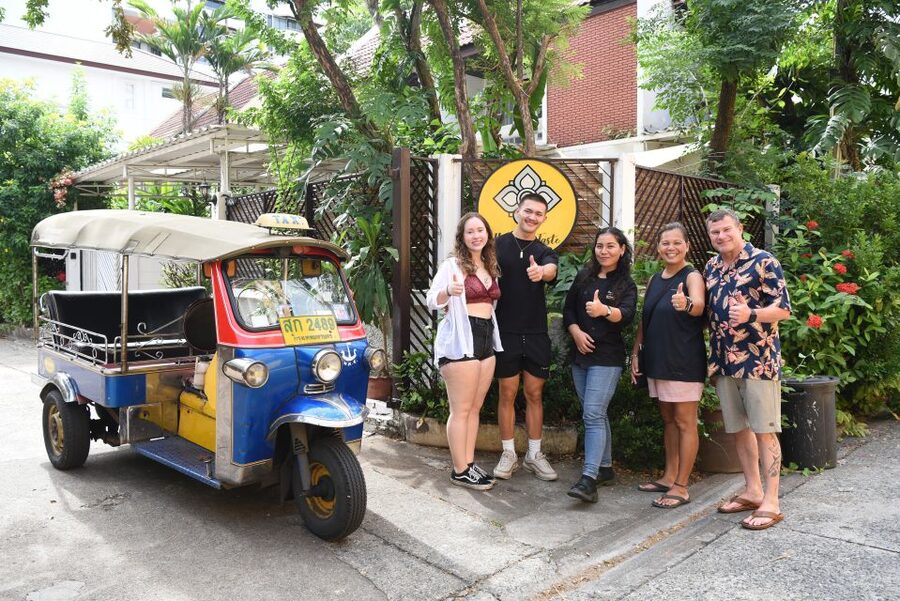
Some morning groups have also enjoyed a short tuk tuk ride to the kitchen. Treat that as a possible part of the morning flow rather than the main reason to book. The cooking and market instruction are the reliable core of the experience.
Afternoon and evening options: mango carving instead
The afternoon and evening classes do not include the market visit. Instead, they offer mango carving, while the introduction to Thai ingredients takes place at the House of Taste Thai Cooking School in Sukhumvit 4.
This schedule difference matters. If seeing a Thai market is high on your Bangkok wish list, choose the morning session and follow the correct meeting instructions. If you prefer a later start, the afternoon or evening class still gives you the ingredient briefing, curry-paste work, cooking, and meal. You simply lose the market setting.
The evening class can suit people who want to keep the daytime free. One smaller evening group found the quieter format especially pleasant. The tradeoff is clear: later sessions are convenient, but they do not provide the market walk.
A clean kitchen and well-organized cooking stations
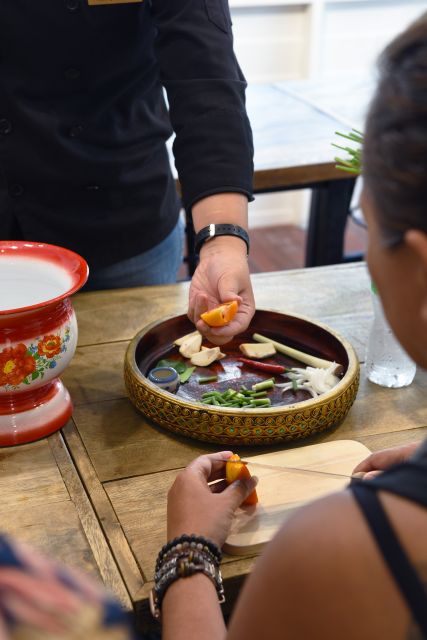
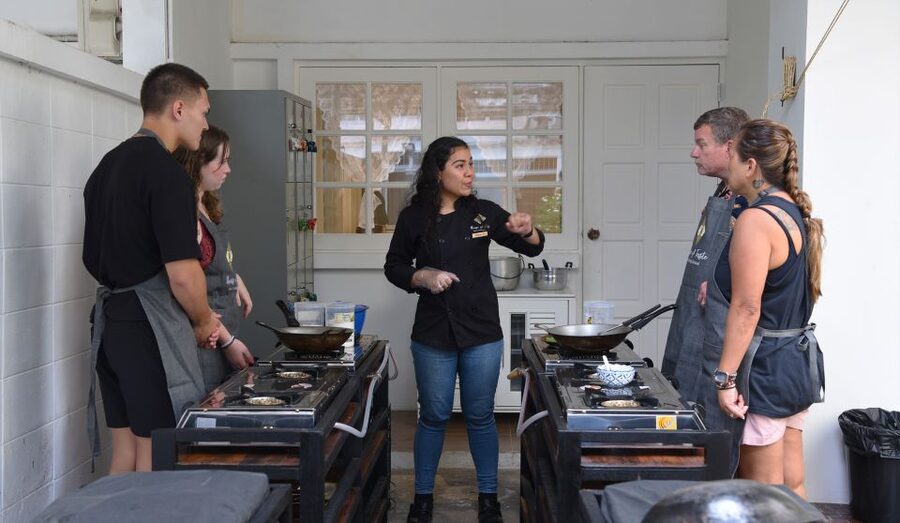
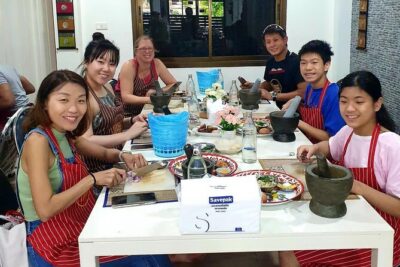
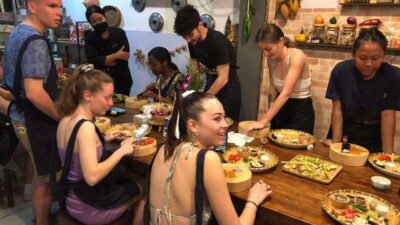
Back at the school, the class shifts from looking to doing. The cooking space is described as modern, clean, and smartly arranged. Each dish has its ingredients organized on a tray, which keeps the lesson moving and makes it easier to focus on technique instead of searching for a missing chili.
The staff handle much of the preparation and tidying, while you take the key cooking steps. That is a good balance for a short class. You get genuine work with the food, but you are not spending half the session peeling every garlic clove for a large group.
The teaching is step by step. April is often praised for her humor and clear explanations, while Jay is noted for explaining how ingredients smell and taste before they are cooked. Pitch is described as professional and thorough, and May receives similar praise for an easy-to-follow class format.
This is a class for beginners, but it is not only for beginners. The useful part for experienced home cooks is the practical sequence: how the ingredients are combined, how the paste is made, and how the dishes are cooked in a sensible order. The school provides all equipment, so you do not need to pack knives or specialty tools.
More Thai Cooking Classes in Bangkok
- Bangkok: Hands-on Thai Cooking Class and Market Tour
★ 4.9 · 1,614 reviews - Bangkok: Tingly Thai Cooking School Half-Day Cooking Class
★ 4.9 · 1,191 reviews - Bangkok: Maliwan Thai Cooking Class with Market Tour
★ 4.9 · 1,133 reviews - Hands on Thai Cooking Class and Market Tour
★ 5.0 · 660 reviews
Making curry paste with your own hands
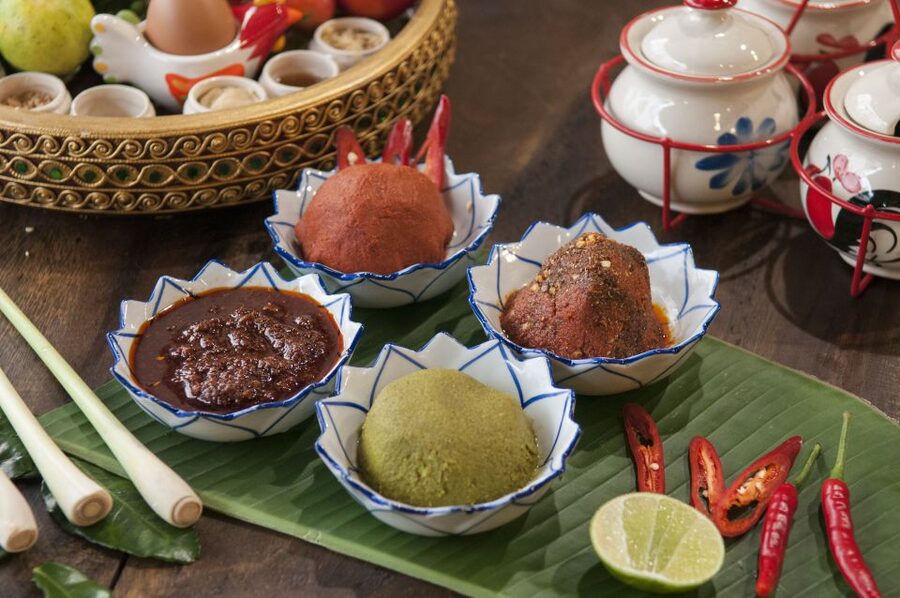
The curry-paste session is the heart of the class. You work with the ingredients rather than watching a chef do everything at the front of the room. That physical step helps you understand why Thai curry has such a layered flavor.
The class also explains coconut milk and curry ingredients from the start. This gives you a better foundation than a recipe that simply says to add curry paste and coconut milk. You learn what goes into the paste and how the parts fit together.
Do not expect to become a Thai curry expert in one afternoon. The class is designed to give you a workable introduction, not a professional kitchen apprenticeship. Still, making the paste yourself is more memorable than opening a packet, and the recipes give you a way to repeat the process at home.
No MSG is used in the cooking. That may matter to you if you are paying close attention to ingredients. Dietary substitutions are available for vegetarian, halal, kosher, and allergy needs, but you must tell the school in advance. One vegetarian participant had chicken replaced with tofu, so substitutions can work well when arranged ahead of time.
Four dishes, cooked and eaten one at a time
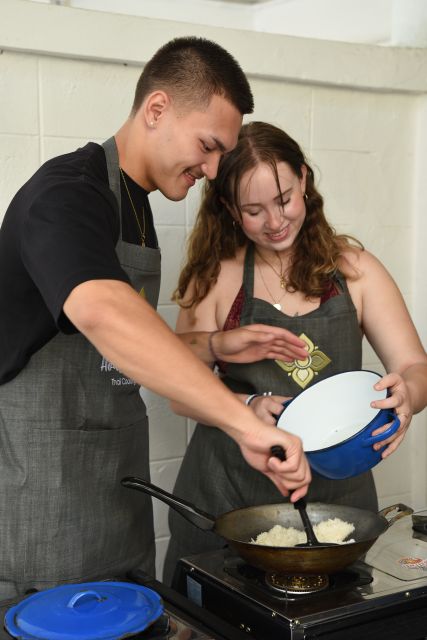
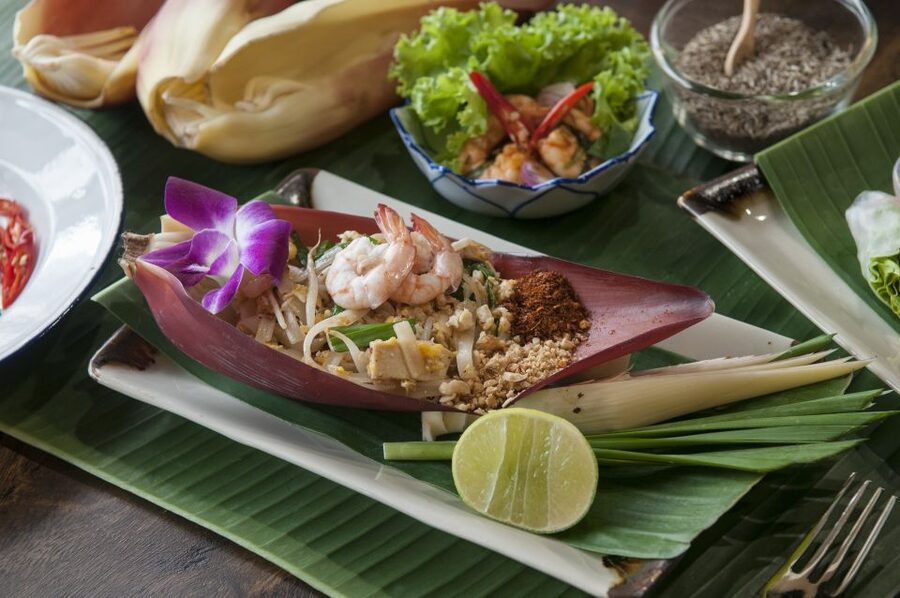
The class includes four traditional Thai dishes. You cook each one, then eat it while it is hot and fresh. This pacing is better than preparing everything at once and facing a crowded plate of cooling food at the end.
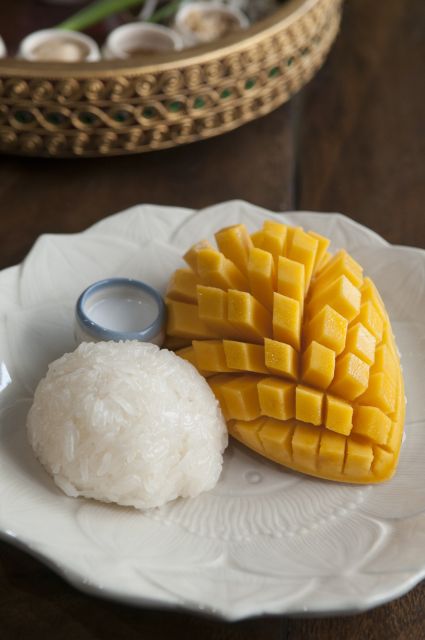
The dessert is always mango sticky rice. It gives the class a sweet finish and balances the stronger flavors of the soups, stir-fries, and curries.
The menu changes by day:
- Monday: Som Tum, Pad Thai with shrimp, green curry with chicken, and mango sticky rice
- Tuesday: Tom Kha Gai, Pad Krapow Gai, red curry with chicken, and mango sticky rice
- Wednesday: Tom Yum Goong, Pad See Ew with chicken, green curry with chicken, and mango sticky rice
- Thursday: Larb Gai, Pad Thai with shrimp, Panang curry with chicken, and mango sticky rice
- Friday: Som Tum, Pad Krapow Gai, red curry with chicken, and mango sticky rice
- Saturday: Tom Kha Gai, Pad Thai with shrimp, green curry with chicken, and mango sticky rice
- Sunday: Tom Yum Goong, Pad See Ew with chicken, Panang curry with chicken, and mango sticky rice
This menu rotation makes the day you choose important. Pick Monday or Friday if papaya salad and basil chicken are your priorities. Choose Wednesday or Sunday for hot and sour soup. Thursday and Sunday feature Panang curry, while red curry appears Tuesday and Friday.
The food quantity is generous. Several people advise arriving with an empty stomach, and that is sensible advice. You are not sampling tiny spoonfuls. You are preparing and eating four proper dishes. If you cannot finish everything, bringing a container could be useful, although take-home leftovers are not listed as an official inclusion.
What the teaching feels like in practice
The strongest part of this experience is the instructor’s presence. The class depends on communication, and the teachers keep the atmosphere relaxed with jokes and friendly encouragement. That matters when you are trying a new technique or handling unfamiliar ingredients.
The pace is generally well managed. You taste each dish as it is completed, and the work is divided so the class keeps moving. Families and teenagers can take part, and a 13-year-old and 16-year-old both enjoyed the activity. Couples, solo participants, and small groups also fit naturally into the format.
The international mix adds a social element without making it the whole point. You work beside people from different countries, then sit down to eat the same food you helped prepare. If you enjoy meeting people through an activity, this is a natural setting for it.
The class is not a serious culinary certification course. You will get clear instructions, but the amount of history behind the dishes may be limited. If you want long discussions of regional Thai cooking, religious food traditions, or the origins of each recipe, you may want a separate food tour as well.
Is $45 a fair price?
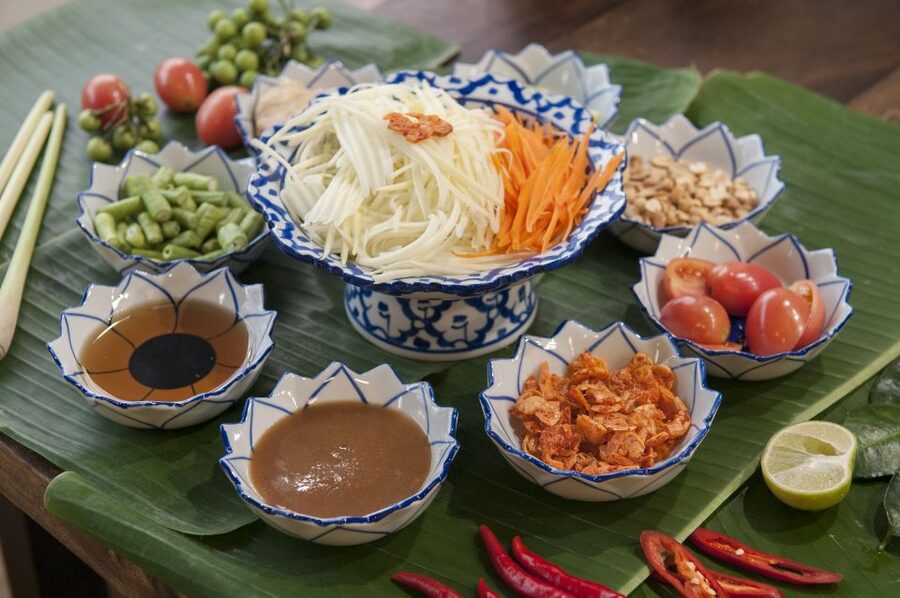
At $45 per person, the value is good if you plan to cook Thai food again. The fee includes the market experience for morning participants, all ingredients, equipment, water, a locker, four dishes, instruction, and recipes by email. You are also paying for the chance to taste your work immediately, which makes the class more than a simple demonstration.
Bangkok has many inexpensive meals, so you should not book this only as a way to save money on lunch. You could eat several Thai meals for less than $45. The value is in the instruction, the ingredient lesson, the social setting, the curry-paste practice, and the recipes you can use after returning home.
The price also makes sense for families and couples who want one planned activity with a meal included. It is less attractive if you dislike group classes, do not enjoy cooking, or want a market tour but can only attend in the afternoon or evening.
Free cancellation up to 24 hours before the activity and the reserve-now-pay-later option add useful flexibility. The instructor works in English and Thai. Wheelchair accessibility is listed, but the activity is also marked as unsuitable for people with mobility impairments, so contact the provider before booking if you have access needs.
Who should book this Sukhumvit class?
I would recommend it to first-time visitors who want an active introduction to Thai food. It is also a good fit for home cooks who want practical recipes rather than a restaurant meal, and for families with older children or teenagers.
Choose the morning class if the market is important to you. Choose afternoon or evening if the schedule is easier and mango carving sounds appealing. Check the daily menu before booking, particularly if you have a favorite curry, soup, salad, or noodle dish.
I would hesitate only if you need a highly detailed history of Thai cuisine, dislike eating a large amount of food, or have mobility concerns that make market walking and class participation difficult. Also, do not arrive at the wrong location: morning groups meet by Asoke, while later groups meet at the school in Sukhumvit 4.
Should you book it?
Yes, if you want to do more than photograph Thai food. The class gives you four dishes, a hands-on curry paste lesson, clear instruction, and recipes for later. The instructors are the great strength, with April, Jay, Pitch, and May repeatedly praised for humor, patience, and careful explanations.
Book the morning session for the fullest experience, and pick your day by its menu. Bring comfortable shoes, arrive with an empty stomach, notify the school about dietary needs, and allow a few extra minutes to find the meeting point. For $45, it is a practical and tasty way to spend half a day in Bangkok.
FAQ
How long does the Thai cooking class last?
The activity lasts 210 minutes, or three and a half hours.
Where does the morning class meet?
Meet at street level near BTS Asoke Exit 3 and MRT Sukhumvit Exit 3. Hey! Coffee MRT Sukhumvit can also be used as a map pin for the meeting point.
Where do the afternoon and evening classes meet?
Afternoon and evening participants meet at House of Taste Thai Cooking School in Sukhumvit 4.
Does every class include a market tour?
No. The market tour is available only with the morning class. Afternoon and evening classes include mango carving instead, with the ingredient introduction held at the school.
How many dishes will I make?
You will prepare four traditional Thai dishes. Mango sticky rice is included every day, while the other three dishes change according to the day of the week.
Can the class accommodate dietary requirements?
Vegetarian, halal, kosher, and allergy-related substitutions can be provided with advance notice. Chicken can be replaced with tofu for a vegetarian participant.
What is included in the $45 price?
The price includes the four-course meal, drinking water, ingredients, cooking equipment, a personal locker, and standard recipes sent by follow-up email. Alcohol is not included but can be purchased.
Just added in Bangkok
- Wonderful Pearl Dinner Cruise★ 3.5 · 27 reviews
- re:leaf spa and massage★ 4.0 · 10 reviews
- White Orchid Sunset Dinner Cruise Calypso Ladyboy Cabaret Show★ 4.0 · 10 reviews
- Yoga in the Park Thailand★ 5.0 · 12 reviews
- Visit Wat Pho and Wat Arun with Local Expert★ 4.0 · 14 reviews
- Visit temples in and around Bangkok with a former monk of 10 years★ 5.0 · 30 reviews
- 3-Hour Bangkok Walking Tour: Wat Pho and Wat Arun★ 5.0 · 102 reviews
- Miracle Bangkok Airport Lounges – Relax Before You Fly★ 3.0 · 32 reviews
Thai Cooking Classes, compared.
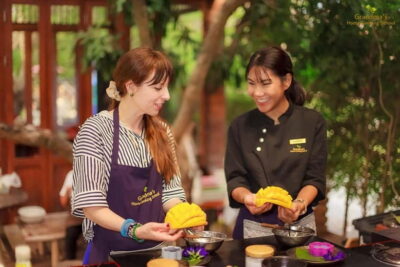
Half-Day Thai Cooking Class at Organic Farm in Chiang Mai
Read our review →
Cooking Class, Market & Thai Herbs Garden Tour
Read our review →Authentic Cooking Class with Market & Farm Visit
Read our review →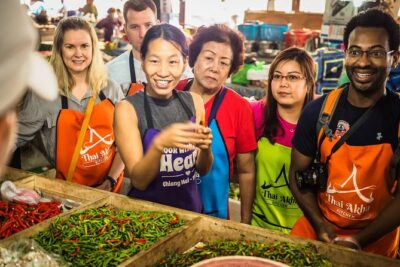
Phuket Thai Cooking Class with Market Tour Option
Read our review →
Tingly Thai Cooking School Half-Day Cooking Class
Read our review →Browse the lists this tour appears in