
Reviewed · PALACES AND HISTORIC SITES
Full-Day Historical Park and Countryside Tour in Sukhothai
Sukhothai is best seen at bicycle speed. I like the quiet ride through canals, rice fields, and village communities before reaching the old capital, and I like that the tour joins everyday life with major temples instead of treating the ruins as a stand-alone attraction. The main consideration is the early start and seven-hour schedule, which may feel demanding in Thailand’s heat.
I also like the small maximum group of 12, the included mountain bike, helmet, lunch, water, snacks, insurance, and hotel transfers. Guide Mem gets special praise for making the morning personal and for helping prepare a shared meal with local residents. If your pickup is more than 15 kilometers from the starting point, or from certain hotels, airports, or the Phitsanulok railway station, extra transport charges apply.
In This Review
- Key points at a glance
- Why this Sukhothai bike tour feels different
- The morning ride through canals and rice fields
- Wat Chetuphon and the southern edge of the old city
- Saritphong Dam and Sukhothai’s water system
- Three small temple stops with very different moods
- Wat Sri Chum and the giant seated Buddha
- Wat Mahathat, the ceremonial heart of Sukhothai
- Wat Sri Sawai and Khmer-style architecture
- What the $51.92 price really covers
- Who should book this seven-hour ride
- Should you book the Sukhothai countryside tour?
- FAQ
- What time does the tour start and finish?
- Is hotel pickup included?
- What equipment is provided?
- Are entrance fees included?
- What food and drinks are included?
- What happens if the weather is poor?
Key points at a glance
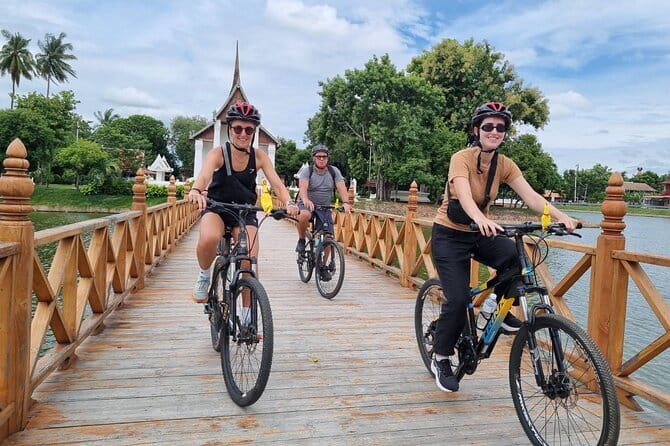
- Canals before temples: You see how waterways support farming, bathing, laundry, and fishing before entering the ancient capital.
- A full seven-hour outing: The ride runs from 8:00 am to about 3:00 pm, with roughly four hours focused on Sukhothai Historical Park.
- Eight significant stops: The route includes Wat Chetuphon, Saritphong Dam, Wat Mangkon, Wat Pa Mamuang, Wat Sri Chum, Wat Mahathat, and Wat Sri Sawai.
- A personal guide makes the difference: Mem is praised for clear, original commentary and for creating a friendly meal experience with local people.
- Good value at $51.92: The price includes equipment, admissions, lunch, drinks, snacks, insurance, guiding, and hotel transfers within the stated area.
- Small-group cycling: A maximum of 12 people keeps the ride more manageable than a large coach excursion.
Why this Sukhothai bike tour feels different
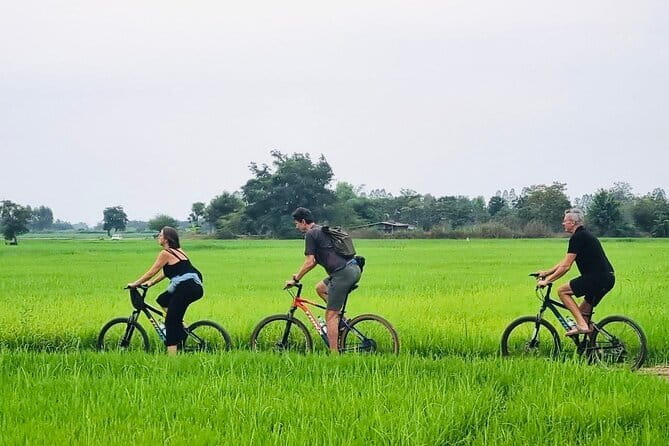
Many Sukhothai visits begin inside the historical park and stay there. This tour takes a slower route to the ruins, following small canals and traffic-free roads through villages, rice paddies, and working countryside.
That opening matters. You are not just moving between temples. You are seeing the systems that still support local life. A canal may carry water to fields, provide a place for washing, or help supply dinner through fishing. The guide explains these practical details as you ride, so the countryside becomes part of the story rather than a backdrop.
I especially like this balance. You get the famous monuments, but you also get an easy introduction to agriculture, village industries, handcrafts, and rural routines. The route gives you a better sense of how Sukhothai functions beyond its archaeological center.
The tour is also active without being framed as a hard cycling challenge. You ride a 24-gear mountain bike with front suspension, and the route uses quiet roads. Still, you should be comfortable spending most of a morning and early afternoon on a bicycle. The heat, sun, and length of the outing are the real tests, not steep mountain roads.
More Palaces and Historic Sites in Thailand:
- From Bangkok: Ayutthaya Temples Guided Tour with Lunch
★ 4.7 · 10,535 reviews - From Bangkok: Ayutthaya & Ayothaya Floating Market Day Trip
★ 4.7 · 6,084 reviews - Bangkok: Grand Palace, Wat Pho, and Wat Arun Guided Tour
★ 4.8 · 3,632 reviews
The morning ride through canals and rice fields
The day begins at 8:00 am. Hotel pickup is included within the stated service area, making an early start easier if you are staying nearby.
The first part leads through local villages, rice fields, and market areas. This is where the tour earns its character. You can hear greetings from local residents and see ordinary work taking place around the canals. The guide discusses farming, agricultural products, village life, and local industry as you go.
Because the route is described as traffic-free, you can pay more attention to the surroundings instead of watching cars. That also makes the ride more approachable for people who want to cycle but do not want to deal with busy roads.
The pace appears designed for looking and listening rather than racing. The countryside section is not just a transfer to the historical park. It is a central part of the experience, and one of the strongest reasons to choose this tour over a standard temple visit.
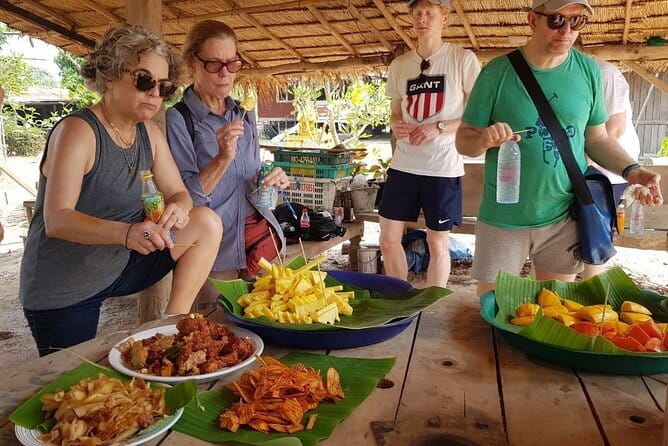
Guide Mem is worth noting here. One particularly warm account praises the way Mem explained daily life during the morning portion. Another describes a lunch prepared with local people, with the group taking part and sharing several tasty dishes. The precise lunch menu is not specified, so you should not book this expecting a named regional specialty. But the shared meal element adds a social touch that a restaurant stop would not provide.
Wat Chetuphon and the southern edge of the old city
The first temple stop is Wat Chetuphon, a large complex in the southern part of the historical park. Its countryside setting, surrounded by rice paddies, gives it a quieter feel than the best-known central ruins.
The temple contains remains of Buddha images in different positions. That makes it useful for understanding how Buddhist art presents the Buddha through posture and gesture, rather than seeing every statue as a variation on the same theme.
You have about 15 minutes here. That is enough for a guide-led introduction and photographs, but it is not a long period for wandering. If you prefer to study every wall and image at your own pace, the schedule may feel brisk. The advantage is that the tour covers a broad range of sites without spending the entire day at only one complex.
Saritphong Dam and Sukhothai’s water system
The next stop is Saritphong Dam, an ancient structure dating to the Sukhothai era. Mountains surround the dam, and the site offers time for views and photographs.
This stop gives useful context to the canals you saw earlier. Water management was not a minor concern for the old capital. The dam supplied water to the city and nearby rice fields, linking royal urban life to agriculture outside the walls.
The visit lasts about 20 minutes. It is a short pause, but it helps explain why waterways appear so often in the wider Sukhothai story. You can also expect this to be one of the more open stops, with less emphasis on detailed temple architecture and more on the setting and practical role of water.
A few more options to weigh up in Thailand
- From Bangkok: Ayutthaya Historical Park Guided Day Trip
★ 4.6 · 3,020 reviews - UNESCO’s Ayutthaya Historical Park: Full-Day Tour from Bangkok
★ 4.5 · 1,559 reviews - From Bangkok: Historical Day Tour to River Kwai
★ 4.6 · 868 reviews - Historical City of Ayutthaya – Unesco Full Day Tour From Bangkok
★ 5.0 · 847 reviews
Three small temple stops with very different moods
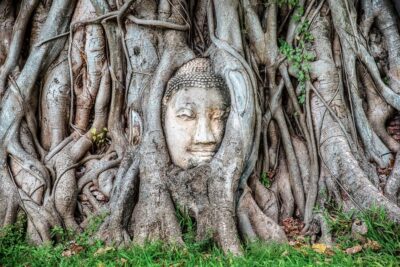
Wat Mangkon comes next, with a Sri Lankan-style chedi. Parts of the complex have been overtaken by strangler fig trees, giving it a more weathered appearance and making it a good place for photographs.
The stop lasts about 15 minutes. It is brief, but the combination of the tower and tree growth offers a clear change from the more formal temple compounds.
Wat Pa Mamuang is smaller and more intimate. The name refers to mango, and the complex sits in a mango forest. The setting is the point here. Rather than another giant monument, you get a compact site where the guide can explain the ruins without the scale of the central park taking over.
You have another 15 minutes at Wat Pa Mamuang. I would treat it as a pause for atmosphere and explanation, not a major archaeological visit.
These two stops show why the route works well by bicycle. You can move between modest temple remains, wooded spaces, fields, and larger monuments in a way that feels connected. A vehicle can cover the same ground, but the transitions would be less noticeable.
Wat Sri Chum and the giant seated Buddha

Wat Sri Chum is one of the day’s visual highlights. It lies in the northern section of the historical park and is known for the enormous Buddha image inside the monthop, or Buddha house.
The statue is shown in the subduing Mara position, a pose linked to the Buddha’s victory over temptation and distraction. The narrow architectural space around the image makes it especially striking. You do not need a long lecture to understand why this is one of Sukhothai’s most memorable places.
The guide leads you through the complex and explains its main features during the 20-minute visit. This is a good example of where a guide adds value. Without context, you see a very large Buddha in a confined building. With a clear explanation of the pose and building, the monument becomes easier to read.
The northern location also helps break up the day. By this point, you have seen countryside, waterworks, small temple sites, and now one of the park’s most famous images.
Wat Mahathat, the ceremonial heart of Sukhothai
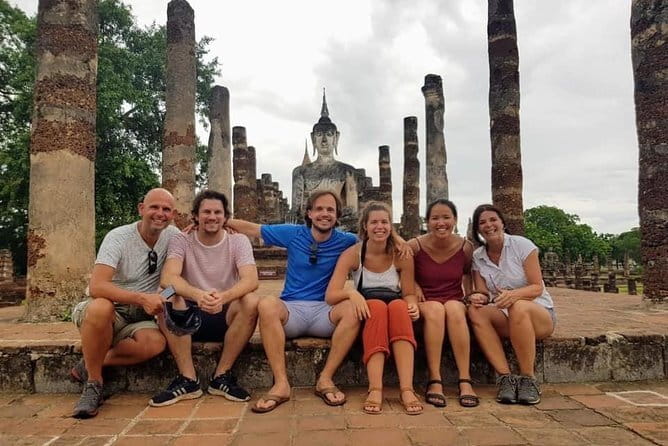
Wat Mahathat receives about 30 minutes, the longest individual temple stop listed for the tour. That makes sense. This is the most famous and impressive complex in the ancient capital, located in the heart of the historical park.
The name means Temple of the Great Relics. Its architecture brings together several styles, reflecting the changing influences and religious needs of the old city. You can expect a broad complex rather than a single isolated building, with many structures to take in during a relatively short visit.
Thirty minutes gives you time to walk with the guide, learn the main points, and take photographs. It will not satisfy someone who wants to inspect every chedi, image, and architectural detail. Still, after several hours of cycling and multiple smaller sites, the focused visit keeps the day from becoming a long, tiring archaeological march.
This is also where the tour’s structure pays off. You arrive already understanding something about water, agriculture, village life, and the less famous temples. Wat Mahathat then feels like the center of a wider historical area, not just a postcard stop.
Wat Sri Sawai and Khmer-style architecture
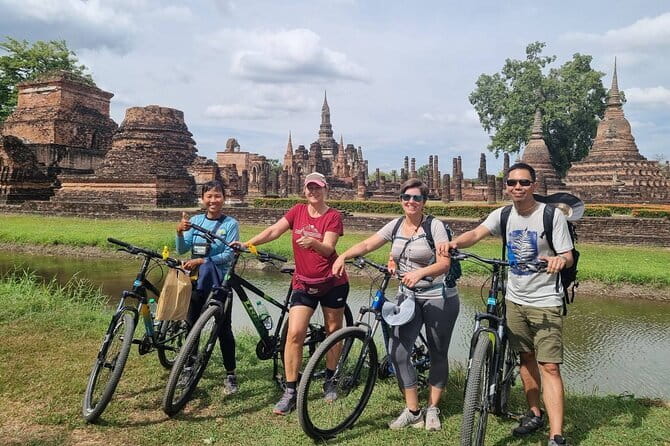
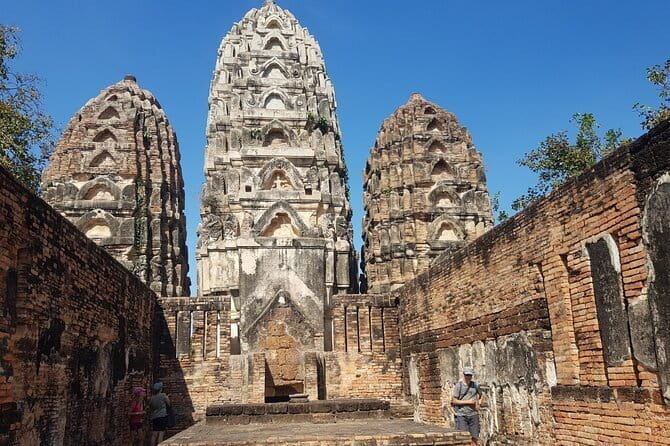
The final listed temple stop is Wat Sri Sawai, a Khmer-style complex with a prayer hall and three prangs, or towers. A brick wall and moat surround the site.
The 20-minute visit gives the guide time to point out how the architecture differs from the Sri Lankan-style chedi at Wat Mangkon and the Buddhist forms seen elsewhere. Sukhothai is often presented as a single artistic style, but this stop shows the older and wider regional influences that shaped the capital.
It is a useful ending because it leaves you with architectural variety in mind. You have seen Buddhist images, Sri Lankan forms, wooded ruins, water infrastructure, and Khmer towers, all within one day.
What the $51.92 price really covers
At $51.92 per person, this is not simply a bicycle rental followed by a ride around the ruins. The cost includes an experienced English-speaking cycling guide, a 24-gear mountain bike with front suspension, a helmet, insurance, entrance fees, lunch, bottled water, a soft drink, a snack, and hotel transfers within the stated pickup area.
That package gives the tour solid value. Entrance fees alone would otherwise be an extra task, and the bike, helmet, and guide remove much of the planning required for a countryside ride. Lunch and drinks are also useful on a seven-hour outing, especially in warm conditions.
The price is less attractive if you are already staying near the park, have your own bicycle, and plan to visit only the central monuments. For that kind of independent visit, you may prefer a shorter rental and more time at each temple.
Extra transport charges are important. Pickup or drop-off more than 15 kilometers from the starting point is not included. The stated additional prices are 1,200 Thai baht for Sukhothai Heritage Hotel or Sukhothai Airport, and 1,500 Thai baht for Phitsanulok railway station or Phitsanulok Airport. Check your exact location before booking so the advertised price does not surprise you later.
Who should book this seven-hour ride
I would choose this tour if you want Sukhothai to feel like a living place, not only an archaeological park. It suits you if you enjoy gentle outdoor activity, local contact, guide commentary, and a full day that mixes scenery with history.
It is especially useful for a first visit because the route covers the major highlights while also showing lesser-known sites such as Wat Chetuphon, Wat Mangkon, and Wat Pa Mamuang. The small group limit of 12 should make instructions and stops easier to manage than on a large organized excursion.
You may want a different plan if you dislike cycling, need a late start, or prefer to spend several hours alone inside Wat Mahathat. The tour has a fixed schedule, and the 15 to 30-minute temple visits leave limited time for private exploration.
Most people can participate, but this is still a physical activity. You should be ready for a seven-hour outing and good enough weather for cycling. The experience requires suitable weather, and if conditions are poor, the operator offers a different date or a full refund.
The cancellation terms are simple: cancel at least 24 hours before the 8:00 am start for a full refund. Cancellations or changes made within 24 hours are not refunded or accepted.
Should you book the Sukhothai countryside tour?
Book it if you want the best mix of rural life, cycling, and ancient temples in one day. The strongest part is the morning route through canals and communities, followed by a well-chosen set of temple stops that includes both famous monuments and quieter corners.
The $51.92 fee is fair because it covers equipment, admissions, food, drinks, insurance, guiding, and eligible hotel transfers. I would make this one of my first choices for an active Sukhothai visit, especially if Mem is leading the ride and you value clear explanations and a shared local meal.
Skip it if your priority is slow, independent temple photography or if seven hours on a bicycle sounds tiring. For everyone else, this is a thoughtful way to see why Sukhothai was more than a collection of beautiful ruins.
FAQ
What time does the tour start and finish?
The tour starts at 8:00 am and lasts about seven hours, finishing at approximately 3:00 pm.
Is hotel pickup included?
Hotel transfers are included within the stated service area. Pickup or drop-off more than 15 kilometers from the starting point costs extra.
What equipment is provided?
You receive a 24-gear mountain bike with front suspension, a helmet, and insurance.
Are entrance fees included?
Yes. All fees and taxes, including admission fees for the listed sites, are included.
What food and drinks are included?
The tour includes lunch, bottled water, a soft drink, and a snack. Alcoholic beverages are not included.
What happens if the weather is poor?
The activity requires good weather. If it is canceled because of poor weather, you can choose another date or receive a full refund.
Just added in Thailand
- Full Day Doi Saket Hiking Tour★ 5.0 · 14 reviews
- Pha Dok Siew Nature Trail & Doi Inthanon National Park From Chiang Mai★ 4.0 · 23 reviews
- One day Elephants in Nature Experience & Grand Canyon Jumping★ 5.0 · 31 reviews
- Chiang Mai to White & Blue Temple, Black Museum & Golden Triangle★ 4.0 · 52 reviews
- One day Doi Inthanon National Park & Trekking on Kew Mae Pan★ 5.0 · 12 reviews
- Private Tour 2 Difference Trails Trekking at Doi Inthanon National Park★ 5.0 · 19 reviews
- Half day Long Neck hill tribe and Hmong hill tribe village★ 5.0 · 21 reviews
- One Day Tour Chiang Rai(White Temple , Blue Temple, Black House) Private Tour★ 5.0 · 63 reviews
Palaces and Historic Sites, compared.
Ayutthaya & Ayothaya Floating Market Day Trip
Read our review →
Grand Palace, Wat Pho, and Wat Arun Guided Tour
Read our review →
Grand Palace and Wat Phra Kaew Guided Walking Tour
Read our review →
Grand Palace, Wat Pho, Wat Arun Sacred & Local Tour
Read our review →
Ayutthaya Temples and River Cruise from Bangkok
Read our review →
UNESCO’s Ayutthaya Historical Park: Full-Day Tour from Bangkok
Read our review →Browse the lists this tour appears in